
Blog
5G Router Price in India 2026: Complete Buying Guide

TL;DR: 5G Router Price India 2026
5G router prices in India range from ₹2,500 to ₹40,000—but 90% of buyers should stop at ₹8,599.
- The reality: True 5G routers cost ₹25-35K, but India’s congested networks deliver only 200-300 Mbps during peak hours in 2026—barely faster than Cat6 4G+ routers at ₹8-10K that deliver 150-250 Mbps.
- Best value: TP-Link MR600 at ₹8,599 captures 80% of 5G router performance at 30% of the cost. It has Cat6 carrier aggregation, external antenna support, and 3-5 year lifespan.
- Buy 5G (₹25K+) ONLY if: You have confirmed strong 5G coverage (tested 7-11 PM), need Wi-Fi 6 for 20+ devices, and are future-proofing for 3-5 years with comfortable budget.
- Hidden truth: Router hardware is only 27% of Year 1 cost—data plans dominate at 37%. Don’t overpay ₹20K for marginal router improvements; invest savings in antennas (₹3-5K), UPS backup (₹2-3K), and premium data plans instead.
If you are confused, why 5G router prices in India range from ₹2,500 to ₹40,000? You’re not alone. When you’re shopping for a cellular router, the price gap can feel overwhelming, especially when two routers look similar but cost wildly different. Here’s the truth: you’re not just paying for speeds. You’re paying for modem chipsets, band support, build quality, and features that determine whether your internet works flawlessly or frustrates you daily.
Think of it like buying a car. A ₹5 lakh hatchback and ₹25 lakh sedan both get you from point A to B, but the engine power, safety features, comfort, and longevity justify the price difference. The same logic applies to routers, where each one delivers very different experiences under the hood.
New to SIM-based routers? Read our 5G SIM router guide for India (2026) to understand how they work, what to check (bands, coverage, plans), and which models make sense for most users
This article focuses purely on price, breaking down what you’re paying for at each tier, hidden costs beyond the sticker price, and which budget level makes sense for your specific needs.
Here’s what you’ll learn:
- Why 5G router prices vary 16x and what justifies these gaps
- What you’re actually paying for at each tier: modem chipsets, manufacturing scale, target markets
- Which price tier matches YOUR budget and usage needs (not what marketing wants you to buy)
- Hidden costs beyond hardware (data plans, antennas, static IP, UPS backup, electricity)
- PR SOLUTION pricing vs Amazon/Flipkart transparency comparison
- 2026 price trend predictions: Should you wait or buy now?
By the end, you’ll know exactly which router delivers the best value for your budget; not the cheapest option, not the most expensive, but the smartest investment for reliable internet that lasts 3-5 years.
Understanding 5G Router pricing in India: Why costs vary
5G router prices in India aren’t random numbers pulled from thin air. The ₹20,000+ gap between a TP-Link MR600 and MikroTik Chateau 5G reflects real differences in components, engineering, and who the product is designed for. Let’s break down exactly where your money goes.
Import duties & GST structure
According to India’s telecom equipment import policies, India’s telecom equipment faces 15-20% import duty plus 18% GST, making Indian retail pricing 30-40% higher than identical products in the US or Europe. This affects all brands equally – TP-Link, MikroTik, Four Faith – so while it explains why Indian prices feel high compared to global pricing, it doesn’t explain the gaps between routers within India.
Manufacturing economies of scale, brand positioning, and target market
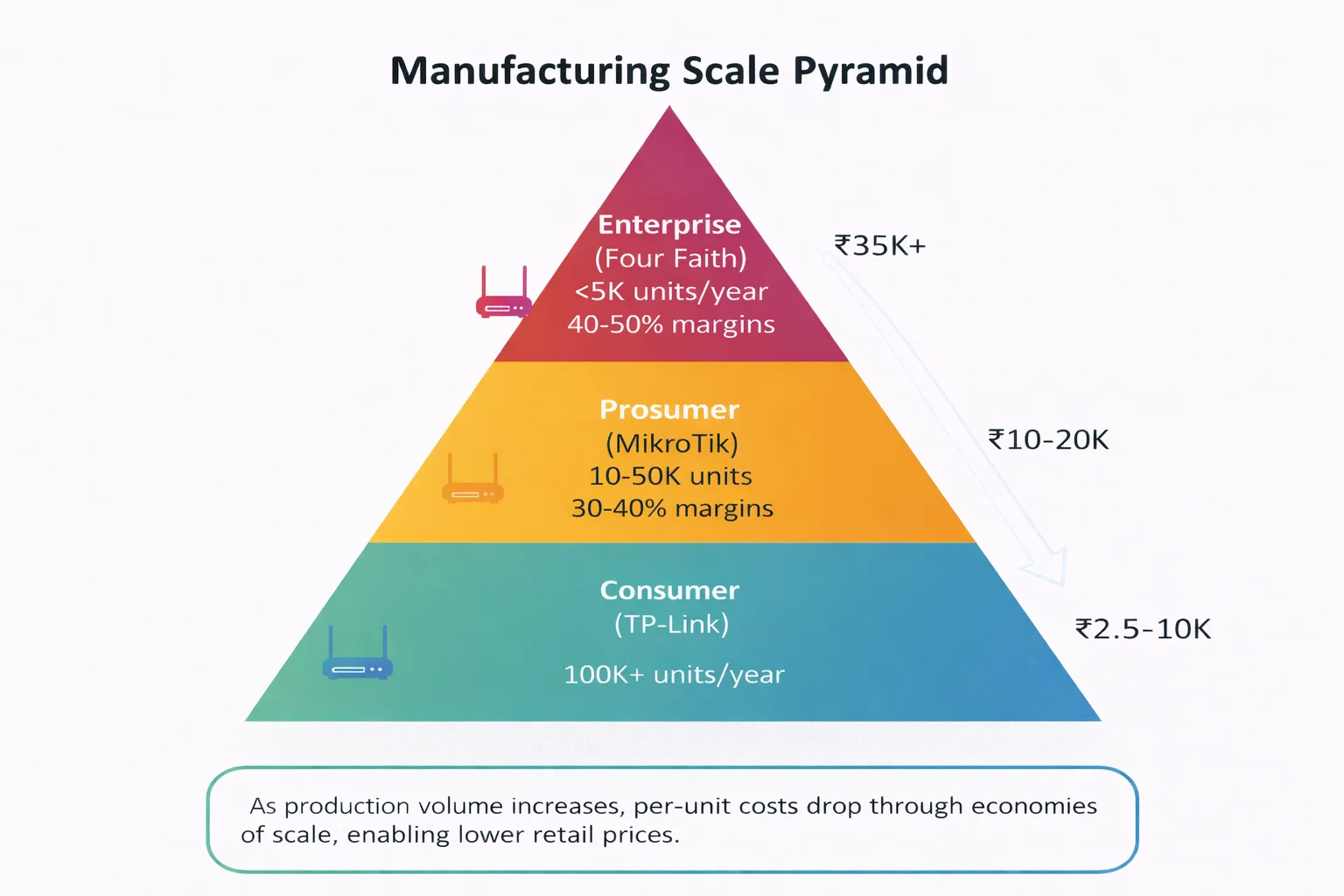
The volume at which a manufacturer produces units dramatically affects per-unit costs. It’s like cooking: making one serving of biryani costs ₹200 per plate. Making 100 servings drops it to ₹80 per plate because you’re buying rice, spices, etc in bulk.
Consumer brands/segments (TP-Link, D-Link):
High volume(100,000+ units/year globally) → plug n play simplicity → economies of scale → competitive pricing → mass market appeal → 15-20% margins
Prosumer brands (MikroTik):
Medium volume (10,000-50,000 units/year) → advanced features for tech enthusiasts → higher per-unit cost → 30-40% margins
Enterprise brands (Four Faith):
Low Volume(<5,000 units/year) → mission-critical specs and reliability→ business buyers with budgets → premium pricing (40-50% margins)
Understanding Modem categories: What you’re actually paying for
When comparing 5G router prices, the modem chipset inside accounts for 40-50% of a router’s final price. Think of it like a car engine: similar-looking vehicles can have vastly different performance and costs based on what’s under the hood. According to Qualcomm’s modem technology specifications, a Cat4 modem costs ₹500-800 while a 5G X62 model costs ₹5,000, which (after R&D, manufacturing, distribution, and 18% GST) explains the ₹2,500 to ₹40,000 retail price range. Here’s what each modem category actually delivers in real-world Indian conditions, and why you might NOT need the expensive option.
| CATEGORY | CAT4 — ENTRY 4G | CAT6 — ADVANCED 4G+ | CAT18 — GIGABIT LTE | 5G X55 — EARLY 5G | 5G X62 / X65 — MODERN 5G |
|---|---|---|---|---|---|
| Real-world speed (India) | 50–100 Mbps | 150–250 Mbps | 300–600 Mbps (ideal)50–150 Mbps gain vs Cat6 in congestion | 200–400 Mbps | 250–500 Mbps |
| Key technology | Single LTE band, No aggregation | 2-carrier aggregation (CA) | 3–5 CA + 4×4 MIMO | Early 5G RF, limited CA | Better RF, power efficiency, CA |
| Latency (typical) | 50–80 ms | 30–60 ms | 30–50 ms | 20–40 ms | 20–40 ms |
| Modem → retail cost | ₹500–800 → ₹2.5K–5K | ₹1.2K–1.8K → ₹5K–10K | ₹2.5K–3.5K → ₹10K–20K | ₹4K–5K → ₹25K–30K | ₹5K–6K → ₹28K–35K |
| What it’s good at | HD streaming, video calls, browsing | Primary home internet, WFH, 10–15 devices | Maxing out 4G with LoS to tower | Early 5G access, lower latency | Better weak-signal handling, efficiency |
| Verdict | Backup internet only. NOT for 4K or many devices. | Best value for ~90% of Indian buyers. 80% of 5G performance at ~30% cost. | Overkill unless LoS + budget ₹20K+ | Good enough for Indian 5G today. Don’t overpay. | Pay premium only for 3–5 year future-proofing or fringe signal areas |
Band support: Why it affects 5G Router pricing
Different 5G bands affect pricing based on component costs and coverage utility in India. Some routers cost ₹3-5K more simply because they support additional frequency bands that provide better indoor penetration or wider coverage.
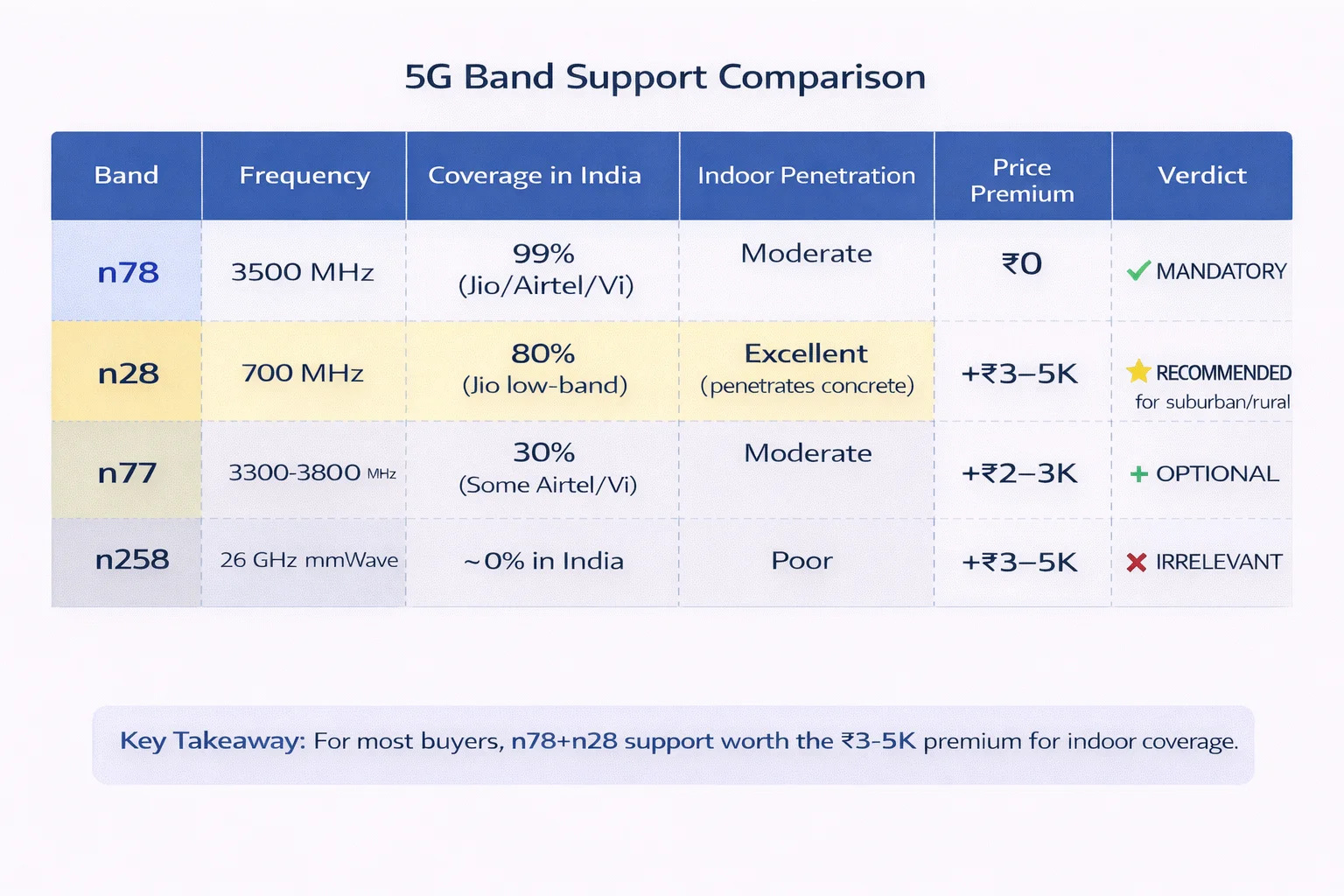
According to Department of Telecommunications 5G spectrum allocation, for Indian 5G networks, n78 is mandatory (99% coverage). n28 adds ₹3-5K to component cost but provides indoor penetration in areas where higher-frequency n78 struggles through concrete walls, and worth it if you’re in a suburban/rural location or have thick RCC construction. n77 and mmWave are not worth paying extra for in 2026.
5G Router price tiers explained (₹2,500 to ₹40,000+)
5G router prices in India cluster into 5 distinct tiers. Here’s exactly what you get at each price point, and who should buy what.
Tier 1: Entry 4G (₹2,500-5,000)
Representative product: TP-Link MR100 (₹2,649)
What you get:
- Cat4 LTE modem (150 Mbps theoretical, 50-100 Mbps real)
- Basic dual-band Wi-Fi
- 2-4 Gigabit Ethernet ports
- Basic web interface, limited features and no external antenna support
Best for: Emergency backup internet, light browsing, temporary setups
Verdict: Only buy if budget is tight (<₹5K). Otherwise save ₹3,000 more for Tier 2.
Real-World Performance:
- Download: 50-100 Mbps in good 4G areas
- Upload: 10-20 Mbps (sufficient for SD/HD streaming, not 4K)
- Connected devices: 5-10 simultaneously without congestion
- Wi-Fi range: 800-1,200 sq ft
Tier 2: Advanced 4G+ (₹5,000-10,000) – Recommended
Representative Products:
- TP-Link MR200 (₹4,999)
- TP-Link MR600 (₹8,599) — Recommended
What you get:
- Cat6 carrier aggregation (300 Mbps theoretical, 150-250 Mbps real-world)
- Dual-band AC Wi-Fi (AC1200 on MR600)
- 4 Gigabit Ethernet ports + external antenna support (2x SMA connectors)
- Advanced web interface (QoS, DDNS, port forwarding)
- Proper heat dissipation (designed for 24/7 operation)
Best for: Primary home internet for families, WFH professionals, small offices (5-10 employees)
Real-world performance:
- Download: 150-250 Mbps (sufficient for 4K streaming, large downloads)
- Connected devices: 10-20 simultaneously
- Wi-Fi range: 1,200-2,000 sq ft
- Lifespan: 3-5 years of reliable use
Why this tier wins:
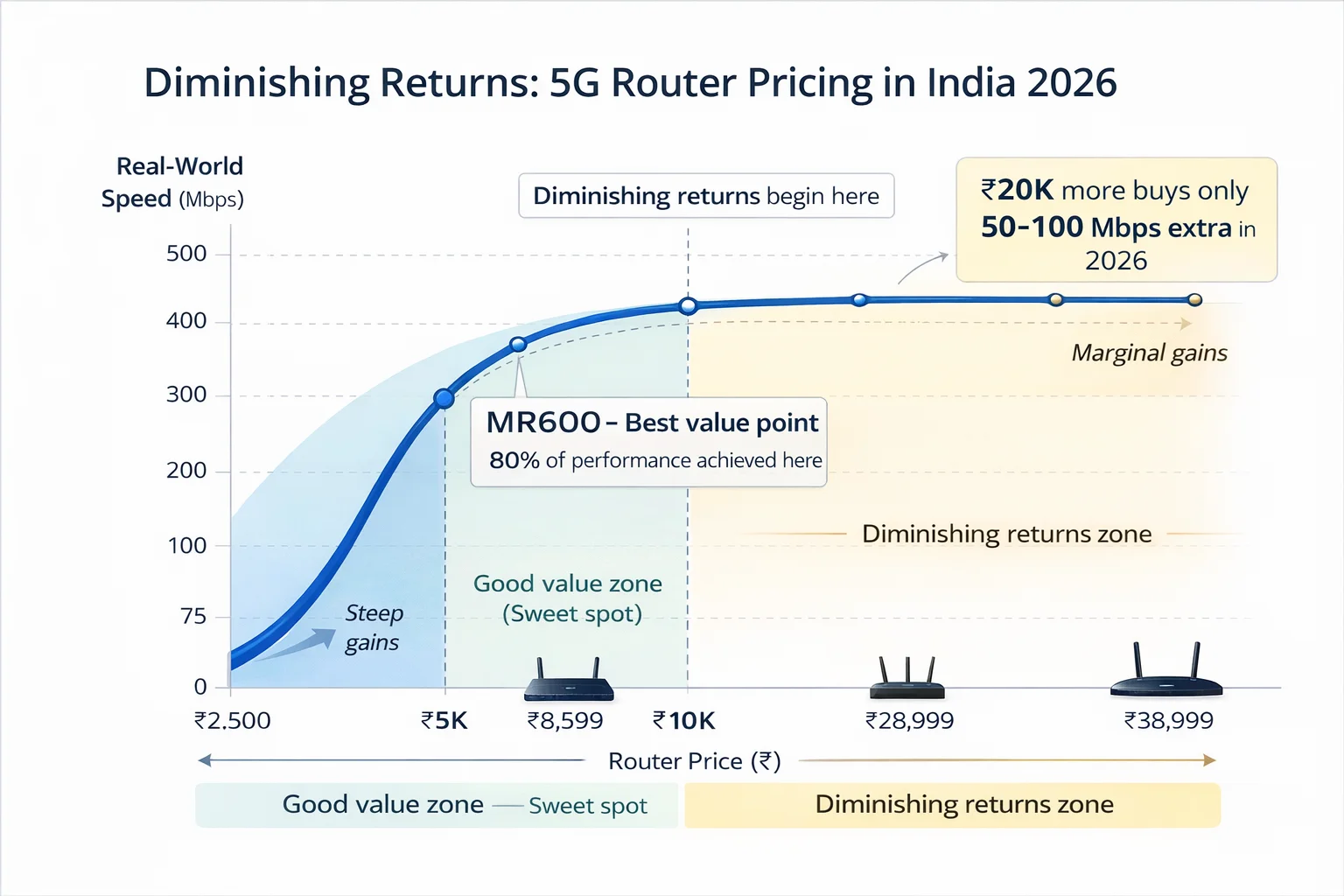
The TP-Link MR600 at ₹8,599 delivers 80% of 5G router performance at 30% of the cost. Real-world speed difference during peak hours: only 50-100 Mbps vs 5G routers.
Tier 3: Prosumer/Outdoor LTE (₹10,000-20,000)
Representative Products:
- MikroTik wAP LTE Kit (₹13,199)
- MikroTik LHGG LTE6 Kit (₹20,199)
What you get:
- Cat6 LTE (same modem as Tier 2) with directional/grid antennas
- Weatherproof IP68 housing (-40°C to +70°C operation)
- RouterOS v7 (advanced routing, VPN, VLANs, firewall, scripting)
- PoE power options for outdoor mounting
- Enterprise-grade build (3-5 year lifespan vs 2-3 for consumer)
Best for:
- Weak signal areas (rural, semi-urban, 1-2 bars indoors) — Primary use case
- Outdoor installations (farmhouses, construction sites, rooftop deployments)
- Tech-savvy users who need advanced routing (VPN, VLANs, custom firewall)
- ISP operators building wireless networks
Real-world performance:
- Download: 200-400 Mbps (with optimal outdoor antenna placement)
- Signal gain: 8-15 dB improvement vs indoor routers
- Range: Can pull usable signal from towers 5-10 km away (clear line of sight)
Tier 4: True 5G Consumer (₹25,000-35,000)
Representative Product: MikroTik Chateau 5G R17 ax (~₹28,999)
What you get:
- 5G X55/X62 modem (supports n78, n77, n28 Indian bands)
- Wi-Fi 6 (AX1800+) for 20-30+ simultaneous devices
- 5 Gigabit Ethernet ports with link aggregation
- External antenna support (4×4 MIMO)
- RouterOS v7 (MikroTik) or advanced web UI (other brands)
- Future-proofing for 3-5 years
Best for:
- Metro users with confirmed strong 5G coverage (tested during peak 7-11 PM)
- Multi-device households (20+ connected devices: laptops, phones, smart home, IoT)
- Users future-proofing for 3-5 years as 5G network capacity expands
- Tech enthusiasts who value latest standards (Wi-Fi 6, 5G SA)
Real-world performance:
- Download: 200-500 Mbps (network-limited, not hardware-limited in 2026)
- Connected devices: 30-50 simultaneously
- Latency: 20-40 ms (vs 30-60 ms on 4G) — better for gaming
Reality Check:
In January 2026, most Indian 5G networks deliver 200-300 Mbps during peak hours due to tower congestion and NOT because hardware limits it. The ₹20,000 premium buys you: future-proofing (3-5 years), Wi-Fi 6 (better multi-device handling), lower latency. But NOT dramatically faster speeds TODAY in congested metros.
Tier 5: Enterprise / Industrial (₹35,000+)
Representative Product: Four Faith FNB600 5G Outdoor CPE (₹39,999)
What you get:
- IP68 weatherproof housing (dust-proof, water-proof, -40°C to +70°C operation)
- Industrial-grade components (5-7 year lifespan vs 3-5 for prosumer)
- Dual-SIM with automatic failover (network redundancy)
- 5G + 4G fallback (seamless switching)
- Enterprise VPN support (IPsec, OpenVPN, WireGuard)
- DIN-rail or pole mounting
- Mission-critical 99.9% uptime design
Best for:
- ISP operators building rural wireless networks (WISP deployments)
- Business-critical installations (ATM networks, CCTV surveillance, IoT gateways)
- Outdoor deployments in extreme conditions (industrial sites, remote telecom towers)
- Enterprise IT buyers with uptime SLAs (99.9% vs 95% consumer-grade)
Verdict: Only buy if you have enterprise requirements (business-critical uptime, harsh outdoor environment, warranty/support contracts). Otherwise, Tier 4 is sufficient.
5G Router price vs performance: What you actually get
Here’s the uncomfortable truth: 5G router prices don’t scale linearly with performance. Beyond ₹10,000, you’re paying for future-proofing and enterprise features; not proportionally faster speeds.
Hidden costs beyond the 5G Router price
The 5G router price you see is just the beginning. Here’s what you’ll actually spend in Year 1 when buying a Tier 2 router (TP-Link MR600), and how to budget for the hidden costs most buyers forget:
| COMPONENT | UPFRONT COST | MONTHLY COST | YEAR 1 TOTAL |
|---|---|---|---|
| Router (Tier 2: MR600) | ₹8,599 | — | ₹8,599 |
| Data plan (200 GB @ ₹999) | — | ₹999 | ₹11,988 |
| External antenna (if weak signal) | ₹3,500 | — | ₹3,500 |
| Static IP (optional for gaming) | — | ₹400 | ₹4,800 |
| Electricity | — | ₹60 | ₹720 |
| UPS backup (optional) | ₹2,500 | — | ₹2,500 |
| TOTAL Year 1 | ₹14,599 | ₹1,459/month | ₹32,107 |
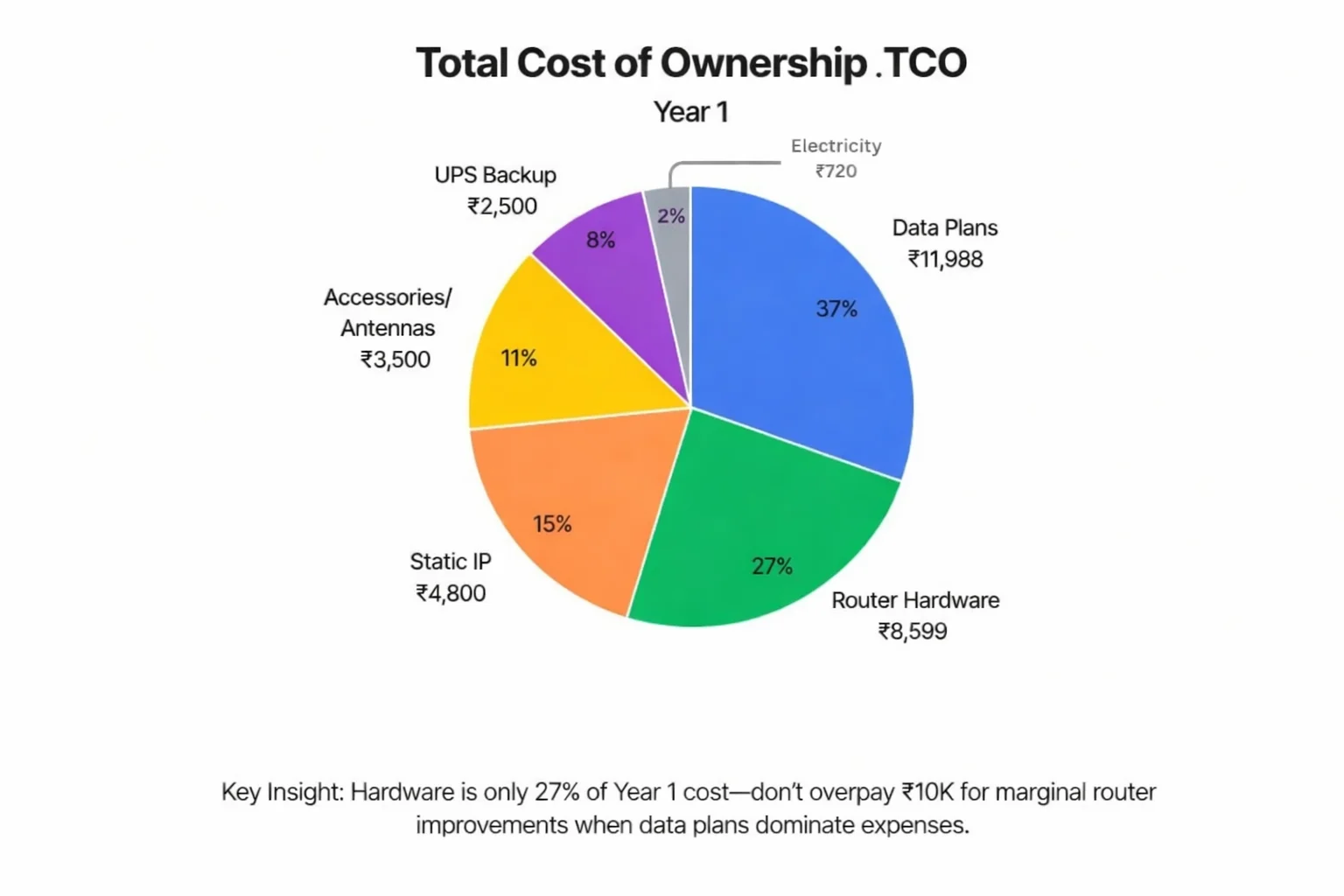
Critical insight: Overpaying ₹5-10K for a router makes little sense when data plans represent the largest cost. Invest savings in better plans or antennas instead.
How to choose a 5G Router based on your budget (decision framework)
Don’t start with features; start with your budget. Here’s exactly which 5G router price tier makes sense for YOUR financial situation and needs.
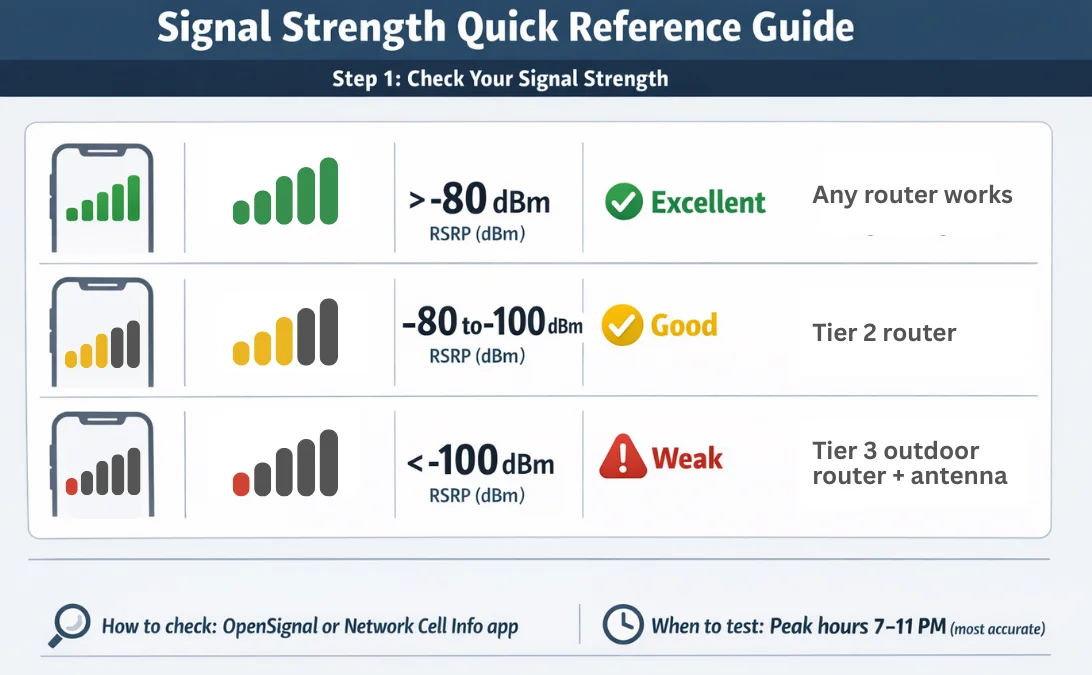
Step 1: Verify coverage FIRST (before budgeting)
Walk around your location during peak hours (7-11 PM) with your phone and check signal strength
Step 2: Match budget tier to your needs
(a)Budget: Under ₹6,000
Best for: Emergency backup internet, temporary setups, budget-constrained students
(b)Budget: ₹8,000-10,000 (90% of buyers stop here)
- Best for: Primary internet, 10-15 devices, 3-5 year lifespan
- Amortized: ₹239/month
(c)Budget: ₹10,000-20,000
- Choose if: Weak signal (1-2 bars) OR need RouterOS features
(d)Budget: ₹25,000-35,000
- Choose ONLY if: Strong 5G tested, 20+ devices, future-proofing priority
- Future-proofing for 3-5 years
We compared PR SOLUTION pricing against Amazon, Flipkart. Here’s what we found – and why authorized retailers like PR SOLUTION offer better value than the numbers suggest.
2026 5G Router price expectations: wait or buy now? (Updated after India’s 6 GHz Wi‑Fi move)
India’s 6 GHz announcement is about Wi‑Fi (Wi‑Fi 6E / Wi‑Fi 7), not 5G cellular, so it won’t make tower speeds better or reduce SIM/FUP risks. What it does change is what “future‑proof” means for premium 5G routers that also serve as your main home/office Wi‑Fi router: at ₹25K+, you should increasingly prefer models that include Wi‑Fi 6E/7 (6 GHz) so your local Wi‑Fi doesn’t become the bottleneck.
Cat6 4G+ Routers (Tier 2):
STABLE at ₹8–10K
Mature market with heavy competition. Component costs are already near the floor. Likely change by Q4 2026: 5–10% drop maximum (₹500–800 savings).
Recommendation: Buy now. Waiting 12 months saves <₹500; not worth months without internet.
True 5G Routers (Tier 4):
SLOW DECLINE ₹28–35K → ₹25–32K by Q4 2026
Qualcomm licensing keeps costs high and competition is limited. Likely change by Q4 2026: 10–15% drop (₹3,000–5,000 savings).
Recommendation: If you need 5G now and your indoor 5G is strong at peak hours, buy. If 5G is patchy, wait 12–18 months.
What could improve value faster than price drops: more Tier 4 launches with Wi‑Fi 6E/7 (6 GHz), plus alternative 5G modem platforms entering India—both can raise “value per rupee” even if 5G modem pricing stays sticky.
Bottom line: Buy now if you need internet today (especially Tier 2). Wait if you’re paying Tier 4 prices mainly for future‑proofing, but your 5G is inconsistent, or if you want your premium router to also be next‑gen on the Wi‑Fi side (6E/7).